




80% of founders report they cut pitch prep from hours to minutes when they adopt modern automation for slides and outreach. That scale change matters in a crowded fundraising market.
The article frames how US startups speed fundraising while protecting credibility with investors. It defines one connected workflow that covers deck creation, list building, outreach, follow-ups, and CRM hygiene in today’s market.
Founders gain time for real conversations because systems handle formatting, link live prospect data, and surface what resonates with prospects. Design automation and engagement analytics are now standard on leading platforms.
The piece sets realistic expectations: these tools assist research, drafting, and iteration, but they do not replace judgment, proof, or founder voice. Practical examples include deck builders, CRM-connected workflows, and deliverability-focused email systems.
Key Takeaways
- One workflow ties deck creation, investor list building, outreach, and CRM together.
- Tools speed formatting and use live prospect data for personalization.
- Engagement analytics reveal what resonates and guide follow-up.
- Systems save founders time so they can meet more investors and close faster.
- Tools assist but do not replace founder judgment or narrative proof.
Why AI is reshaping fundraising workflows for US startups right now
Investors triage opportunities rapidly, so startups must surface clear traction early. In Q2 2025 global venture funding topped $94.6B for the third straight quarter, and private equity AUM hit $10.8T. That scale raises competition for attention and compresses response windows.
What competition looks like in the present market
More outreach volume and shorter reply windows mean founders face higher expectations for accuracy and clarity. Sixty percent of investors now prioritize long-term growth, so pitches must show defensible logic quickly.
Where founders save the most time without losing credibility
High-impact automation compresses repetitive research, drafts structured narratives, and keeps updates consistent across deck, CRM, and outreach sequences. Smart matching can cut prospecting time by roughly 65% and improve conversion rates.
- Compress research and target better leads.
- Draft clear, repeatable messaging that preserves founder voice.
- Standardize updates so metrics and claims stay accurate.
Credibility matters: systems must never invent metrics or fake personalization. Workflow design — not more automation — protects reputation and improves fundraising results by lifting reply rates and shortening time-to-meeting.
Pick the right AI tools and platforms for pitch decks and outreach
Choosing the right stack shortens prep time and keeps message quality high. Founders should prioritize brand control, export fidelity, real-time data sync, and collaboration when selecting tools. A single source of truth prevents duplicate outreach and stale pipeline entries.
Pitch deck tools that stay on-brand
Compare rapid generators like Gamma with design-first platforms such as Beautiful.ai. Pitch adds slide-level analytics and deal-room sharing. monday CRM couples pitch orchestration with CRM sync for pipeline hygiene.
Investor discovery and matching platforms
Platforms like Crunchbase, Signal by NFX, and AngelList help filter leads by stage and thesis. Foundersuite and Gust map contacts and keep leads from going cold.
Outreach execution and CRM integration
Choose outreach tools that protect deliverability, support sequencing, and log activity to your CRM. Examples include Mixmax, Instantly.ai, Clay, and HubSpot; Evalyze.ai adds analytics for message testing.
| Platform | Focus | Note |
|---|---|---|
| Gamma | Rapid generation | Plus/Pro tiers with analytics |
| Beautiful.ai | Design consistency | Brand kit enforcement |
| Pitch | Rooms & analytics | Slide-level tracking |
- Selection criteria: brand control, export quality, collaboration, analytics, CRM integration.
- Pick one system of record and limit tool sprawl so automation speeds the process without breaking it.
Prep the inputs AI needs to produce an investor-ready deck and message
A well-prepared founder supplies organized data and narrative inputs so tools can format—not invent—the story.
Traction, metrics, and insights to gather before prompting
List current traction points and hard metrics first. Include revenue, retention, activation, CAC/LTV where applicable.
Add burn, runway, pipeline signals, and near-term milestones. Investors prioritize long-term growth; outdated numbers harm credibility quickly.
Market narrative and positioning details to clarify
Define category, competitive alternatives, wedge strategy, and the “why now” argument. Turn raw information into clear insights about what drives growth.
Data room basics for fast follow-through
Prepare a secure folder with the financial model, cap table, key customer references, roadmap, and compliance notes. DocSend-style sharing also gives engagement tracking.
- Proof-first drafting: validate every claim and keep version control.
- Better inputs cut back-and-forth and speed the path from first message to meeting.
| Input | Why it matters | Example |
|---|---|---|
| Revenue & unit metrics | Shows traction and model health | ARR, MRR, CAC/LTV |
| Customer proof | Builds credibility | Case studies, references |
| Market positioning | Explains defensibility and growth | Category, competitors, wedge |
Using AI to create pitch deck and investor outreach emails as one connected workflow
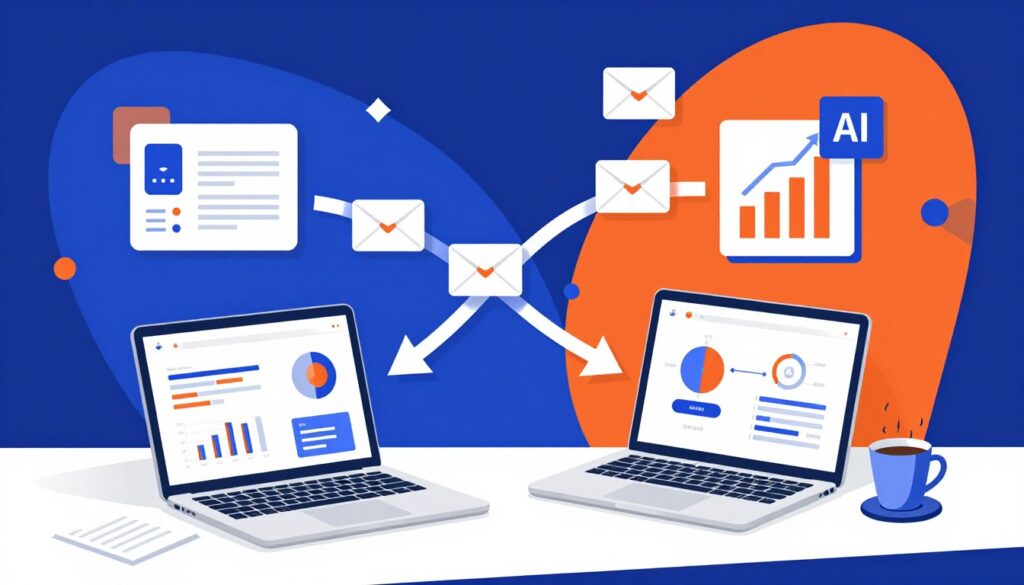
A single, connected workflow prevents conflicting versions and keeps outreach aligned with the story investors see.
Build one source of truth: integrate real-time data with the deck narrative and outreach sequences so every touchpoint pulls the same metrics. This integration preserves accuracy and boosts meeting conversion by reducing missed follow-ups.
Where to standardize, where to personalize
Standardize core sections, compliance-safe copy, and follow-up sequences with templates to speed work and protect quality.
Manually personalize the first two lines of an email, the why-this-investor paragraph, and any claims tied to a portfolio thesis.
| Element | Standardize (templates) | Personalize |
|---|---|---|
| Deck sections | Problem, solution, metrics | Investor-specific examples |
| Outreach | Follow-up cadence, compliance copy | Opening lines, why this investor |
| Tracking | Automated logging | Review before send |
Governance and rhythm
Automate enrichment, reminders, and sequencing, but keep human approval for claims. A small team should set weekly metric refreshes, a deck update cadence, and batch outreach windows.
- Who owns the narrative: founder or lead comms.
- Approve templates centrally and review any automated content before it reaches investors.
- Good workflow and accurate tracking improve outreach results and reduce errors.
Create the pitch deck with AI, then refine it like an investor will
Begin with the problem statement and build each slide so it answers an investor’s core question.
Prompting a proven structure
Ask for a clear sequence: problem, solution, market, traction, model, and team. Supply verified metrics and market assumptions so the output formats facts, not fiction.
Design automation and export checks
Enforce brand fonts, colors, and layout rules across slides. Use smart layouts to keep visuals consistent and readable.
Run export checks in PDF and native slide formats to confirm images, fonts, and links render correctly.
Personalization per meeting
Sync CRM fields—firm, partner focus, prior deals—and merge them into the first two slides and the investor-specific example slide. This keeps the deck on-brand while feeling tailored for each meeting.
Engagement analytics and iteration
Track time-on-slide, drop-off points, and repeated views. Use engagement data to tighten narrative, add proof where viewers exit, and refine follow-up messages.
- Example platforms: Pitch for share links and analytics, Beautiful.ai for brand consistency, Gamma for rapid generation.
- Best practice: iterate with metrics-driven edits and re-test; founders often cut prep time from ~4 hours to ~30 minutes for priority meetings.
Build a high-fit investor list faster with AI-powered research
Speed and precision in sourcing lead directly to better response and fewer wasted touches. Start with clear filters and verified portfolio signals before any outreach.

Stage, check size, and geography filters that prevent wasted outreach
Define stage, check range, and geography to stop mismatches. Filter for lead-role frequency and deployment pace so founders contact only aligned investors.
Portfolio and thesis analysis to explain “why this investor” credibly
Scan recent portfolio moves and public remarks. Use platforms like Crunchbase, AngelList, Signal by NFX, Qubit Capital, Foundersuite, and Gust for source signals.
Then craft a one-line reason that cites a real deal or public thesis. That beats generic flattery and raises reply rates.
Warm introductions and relationship mapping to increase connection rates
Map mutual connections and request intros with a tight, forwardable pitch summary. Warm intros and mapped connections lift meeting conversion significantly.
- Quick wins: apply stage + ticket + geography filters first.
- Summarize public blogs, interviews, and portfolios into short insights for the outreach note.
- Log sources and mark qualified leads so follow-ups stay coherent and trackable.
| Filter | Why it matters | How founders act |
|---|---|---|
| Stage | Prevents pitch to mismatched strategies | Only target investors active at your stage |
| Check size | Avoids wasted asks and preserves credibility | Match ticket range to your round target |
| Portfolio fit | Enables a credible “why” line | Reference a recent, relevant investment |
| Warm intro | Boosts reply and meeting rates | Identify mutual contacts and request an intro |
Governance: define what counts as a qualified lead, log sources, and refresh the list weekly. Well-scoped lists reduce noise, increase connection, and raise meeting rates for faster funding.
Write investor outreach emails with AI while keeping a human voice
High-signal outreach focuses on measurable traction and a short, honest ask that respects an investor’s time.
Subject line strategy: favor clarity over cleverness. Use a concise subject line that signals relevance: stage, metric, or mutual link. A/B test two variants for open and reply performance. Track which subject lines lift both open rate and reply rate, then standardize winners into templates.
Opening lines that prove real personalization
Lead with a single, specific detail: a recent portfolio move, a public comment, or a shared connection. Avoid empty praise or generic merges.
This demonstrates research and earns attention in the first 10 seconds.
Body copy structure
Use a tight sequence: one sentence on what the company does, one on traction with a clear metric, one on why now and long-term growth, and one clear ask.
Example: short product line, ARR or user growth, market timing, then two proposed meeting times or a calendar link.
CTAs that drive meetings
- Offer two specific windows and a calendar link for low friction.
- Give an option for a brief intro call or a longer demo if requested.
- Keep the CTA single and obvious; stronger CTAs raise meeting conversion.
Attachment strategy
Start with a one-page teaser or single-slide summary. Share the full deck only after interest is confirmed. Provide a data room link when an investor asks for diligence.
| When | Attachment | Why |
|---|---|---|
| Initial outreach | One-page teaser | Low friction, sparks replies |
| After positive reply | Full deck (PDF or link) | Supports meeting prep |
| Due diligence | Data room | Provides verified data securely |
Governance note: use templates for structure but require founder review for tone, accuracy, and the “why this investor” line. When genuine founder input guides each message, reply rates can improve roughly 30–33% over generic automated copies.
Automate follow-ups and sequencing without sounding automated
A strategic follow-up plan keeps talks moving without repeating the same ask. Automation should preserve tone and factual accuracy while handling volume. Founders rely on a mix of channels, timed sends, and human review to maintain momentum.

Multi-touch cadence across email and LinkedIn
Best practice uses 8–12 touchpoints across 3–5 weeks and mixes email and LinkedIn. Start with email, then add a LinkedIn note after two email attempts. Pause sequences when a prospect opens repeatedly or responds.
Follow-ups that add value, not reminders
Each message should bring new information: a customer win, month-over-month metrics, a product milestone, or a short market insight. These updates show progress and respect an investor’s time.
Deliverability basics and practical controls
Warm domains before volume, avoid spam-trigger language, and limit links and attachments in early messages. Use deliverability platforms for warming and monitor bounce and complaint rates.
- Schedule sends in business hours and rotate inboxes responsibly.
- Log every touch in the CRM so tracking and timing stay accurate.
- Require a quick human review before any automated message is sent.
| Stage | Channel | Example content |
|---|---|---|
| Initial | One-line intro + key metric | |
| Mid sequence | Short note referencing a public post + update | |
| Later | Value update (customer win or metric) + call ask |
Track metrics, engagement, and results to continuously improve outreach
Track measurable signals across outreach and deck views so the team treats fundraising as a repeatable, data-driven process. Good tracking turns scattered touches into a managed workflow and gives the team clear next steps.
Core KPIs founders and their team should monitor
Focus on open rates, reply rates, meeting conversion, and fundraising velocity. These metrics reveal whether targeting, message, or asset quality needs work.
- Open rates — early indicator of subject and list quality.
- Reply rates — shows message relevance and CTA strength.
- Meeting conversion — the most direct path to results and faster fundraising.
Use slide-level analytics and email tracking to refine messaging
Time-on-slide and view tracking show which proof points attract investor attention. If viewers linger on unit economics, move that evidence earlier in the pitch deck.
Email tracking helps test subject lines and value propositions. Use these signals responsibly: avoid over-indexing on opens when meeting conversion is the true goal.
Pipeline tracking in a CRM prevents warm leads from going cold
Standardize stages, assign a single owner per relationship, and set automated reminders. Unified data reduces lost information and keeps follow-ups timely.
| Metric | What it signals | Action |
|---|---|---|
| Open rate | List & subject fit | Test subject lines; re-segment list |
| Time-on-slide | Resonant proof points | Reorder slides; add early proof |
| Meeting conversion | Message × targeting match | Adjust targeting or message; A/B test |
Run a weekly review loop: update data, review results, adjust templates, and re-segment outreach lists. Small, repeatable lifts in rates and engagement compound and can materially shorten fundraising time.
Conclusion
A concise, repeatable workflow ties verified inputs, targeted research, and polished outreach into measurable fundraising progress.
Start with validated information, build an investor-ready pitch deck, and target investors by fit. Then send clear email notes with a focused subject and human-first opening lines.
Standardize core sections and templates, but keep the first lines and the subject personal. That balance protects credibility while saving founders significant time.
Track engagement, run small experiments, and iterate on results. Use a minimal stack and connect the CRM so outreach and deck views feed a single source of truth.
The goal is simple: better conversations, more meetings, and faster funding with less wasted time. Treat this guide as a workflow for continuous improvement.
FAQs
What tool should startups use to create an AI-powered pitch deck?
Startups should use pitch deck platforms that support brand control, export quality, analytics, and CRM integration. Tools such as Gamma, Beautiful.ai, and Pitch allow founders to automate slide design while keeping their pitch aligned with verified metrics and consistent brand visuals.
How does AI improve the investor outreach process for founders?
AI streamlines the investor outreach process by helping founders research qualified investors, draft personalized messages, automate follow-ups, and log all activity into a CRM. This makes outreach faster, more consistent, and more measurable without sacrificing credibility.
What features should a fundraising platform include for effective funding outreach?
A fundraising platform should include pitch deck creation, investor discovery, email sequencing, CRM syncing, engagement analytics, deliverability controls, and secure document sharing. These features help founders manage outreach campaigns and move leads efficiently through the funding pipeline.
How do founders use AI tools to write better investor outreach emails?
Founders use AI tools to draft structured, concise email messages that highlight traction, clarify the pitch, and personalize the “why this investor” section. AI accelerates writing, while founders review all content to preserve authenticity and factual accuracy.
What platforms help startups build investor lists and manage funding pipelines?
Platforms like Crunchbase, AngelList, Signal by NFX, Foundersuite, and Gust help startups source qualified investors, map warm introductions, and manage funding pipelines in a CRM-connected workflow.
Can AI tools replace founders in fundraising communication?
No. AI tools support founders by handling research, formatting, and draft creation, but founders remain responsible for final messaging, relationship building, and ensuring the accuracy of every pitch and funding claim.
How can startups track results from investor outreach campaigns?
Startups track investor outreach performance using email analytics, slide engagement data, and CRM pipelines. Key metrics include open rates, reply rates, meeting conversions, and fundraising velocity, which help founders continuously refine their pitch and messaging.