



Can a single platform cut downtime, speed root-cause fixes, and let your teams sleep easier?
This article explains what AIOps means in 2025 and how modern tools use machine learning, big data, and automation to analyze logs, metrics, and events in real time.
We focus on platforms that aim for proactive, self-healing IT operations at scale — not generic solutions for wider business use. Expect a buyer-oriented roundup that helps procurement and engineering teams compare options for cloud and hybrid environments.
Coverage previews: correlation and anomaly detection, root-cause analysis, automation depth, ITSM and collaboration links, and clear pricing signals where vendors publish entry rates or quote models. Each tool summary will list ideal fit, strengths, trade-offs, and practical adoption notes for quick shortlisting.
Key Takeaways
- Learn how platforms reduce downtime with predictive monitoring and automated remediation.
- See evaluation criteria: correlation, anomaly detection, RCA, automation, and ITSM integration.
- Find context for hybrid data centers, multi-cloud, and governance needs.
- Understand pricing signals and how they affect procurement and consolidation decisions.
- Each tool section highlights fit, strengths, trade-offs, and adoption notes for teams.
- For a deeper vendor overview, check this practical guide on AIOps options: AIOps vendor roundup.
What AIOps tools are and how they work in modern IT operations
Modern operations need systems that turn streams of telemetry into fast, reliable action.
Definition and scope: AIOps is a discipline and a category of tools that applies machine learning and artificial intelligence across the IT lifecycle. It is more than a dashboard; it fuses telemetry to give teams usable context and faster analysis.
Continuous data ingestion from logs, metrics, events, and traces
Platforms ingest logs, metrics, traces, and events continuously to build a unified view. This real-time data stream prevents blind spots that happen when signals are handled in isolation.
Noise reduction and event correlation to cut alert fatigue
Deduplication and correlation group related signals into a single incident. That reduces noise and on-call fatigue by cutting repetitive alerts and clustering related issues.
Anomaly detection, dynamic baselines, and predictive analytics
Models learn normal behavior as load and topology change. Dynamic baselines spot anomalies that static thresholds miss. Predictive analytics then surface capacity and performance risk before users see issues.
Root cause analysis and automated remediation workflows
Topology mapping and correlation narrow potential causes rapidly. From there, policy-driven automation can restart services, scale resources, or open tickets. Workflows range from auto-actions to approvals for self-healing.
- Key capabilities: continuous ingestion, noise control, anomaly detection, RCA, and automation.
- Buyer outcomes: lower downtime, fewer pages, faster resolution, and better user experience.
Why AIOps matters in 2026 for teams
Modern operations run across public cloud and on-prem systems, creating scale and complexity that manual monitoring cannot manage.
Cloud scale and hybrid infrastructure complexity
Rapid cloud adoption sits alongside legacy systems. That hybrid mix produces fragmented telemetry and blind spots.
Unified telemetry helps teams correlate logs, metrics, and events so they can find root causes faster and reduce mean time to detection and mean time to resolution.
Always-on services and faster incident expectations
Digital banking, commerce, and telecom demand near-zero downtime. Slower triage means lost revenue, higher churn, and SLA penalties.
Automation and routing let small teams do more work in less time without burning senior engineers on routine fixes.
Security, audit readiness, and compliance pressure
Cyber risk is rising, and governance needs clear evidence trails. Integrated telemetry improves security posture and speeds investigations.
- For business: audit-ready logs and change visibility reduce scramble during SOC 2 or ISO reviews.
- For operations: tighter integration between ops and security shortens containment time and closes gaps.
How we evaluated AI Ops tools for real operational impact
Practical impact was our north star: fewer noisy pages, faster RCA, and safer automated fixes. We rated each platform by outcomes that matter to operations teams.
Core capability checks
Correlation quality and RCA accuracy determine how quickly teams find root causes. We scored automation depth and service-level visibility, not just host metrics.
Real-time monitoring and alerting
Buyers need low latency ingestion, clear retention limits, and fast pivots from alerts to logs and traces. Alert maturity was judged by deduplication, grouping, suppression windows, and escalation support.
Log analytics and integrations
Search performance, parsing accuracy, and cost controls matter for heavy data environments. We treated cloud, Kubernetes, ITSM, and collaboration integrations as first-class requirements to avoid brittle glue code.
Governance and security
RBAC, audit logs, SSO/SAML, and approval gates for automation kept remediation safe. Our rubric links these controls to measurable gains: lower MTTD/MTTR, fewer alerts, and higher change success.
- Scoring rubric: outcome metrics, capability depth, integration breadth, and governance strength.
- Why it matters: reliable monitoring and robust management reduce risk and improve performance for operations teams.
For workflow automation examples and integration ideas, see automation and workflow.
Selection checklist for the best ai ops software
Prioritize tools that give you fast, evidence-backed answers instead of more dashboards to monitor.
Data coverage: Confirm the platform ingests logs, metrics, traces, ticket records, and topology/CMDB context. Full coverage makes correlation and RCA accurate across hybrid systems.
Noise control: Look for deduplication, grouping rules, suppression windows, maintenance modes, and priority scoring to cut alert noise and reduce on-call fatigue.
- Incident workflows: Routing to the right team, escalation policies, runbooks/playbooks, and orchestration across chat and ITSM.
- Visibility: Service health scoring, SLIs/SLOs, and business impact views for leadership—not just engineer-facing dashboards.
- Automation depth: Suggestions → policy-driven actions → safe self-healing with approval gates and rollback plans.
- Deployment fit: Cloud-native and on-prem agents, hybrid networking, and data residency controls for deployments.
Proof step: Run a pilot that measures time-to-detect, time-to-resolve, and alert volume reduction. Use these KPI results before enterprise rollout.
Freshservice for no-code AIOps plus ITSM workflows
For teams that need tight ITSM and quick wins, Freshservice ties alert correlation to executable workflows with minimal engineering effort.
What it does: Freshservice combines alert correlation, RCA suggestions, autonomous remediation, and predictive analytics into a single platform. Freddy AI and GenAI Ops add automatic incident summarization, suggested root-cause paths, and knowledge-article generation to cut repeat work.
Why it fits mid-size to enterprise teams: The no-code workflow builder speeds rollout. Teams can create routing, approvals, and remediation playbooks without heavy engineering. That lowers implementation complexity for operations and service management groups.
- Integrations: Azure AD, Microsoft Teams, Slack, Jira, TeamViewer, SecPod for common enterprise flows.
- Reported impact: OdontoCompany saw a 92% rise in first-contact resolution during a 60% ticket surge; Databricks recorded 23% self-service deflection and 96% CSAT; TaylorMade halved resolution time with full workflow automation.
- Pilot checks: validate data ingestion breadth, correlation accuracy, and playbook rollback safety before full rollout.
| Capability | What to expect | Why it matters |
|---|---|---|
| Alert correlation | Groups related alerts into incidents | Reduces noise and on-call pages |
| Freddy AI / GenAI Ops | Summaries, RCA suggestions, knowledge creation | Speeds triage and reduces repeat incidents |
| No-code workflows | Visual playbooks, approvals, remediation | Faster time-to-value with lower engineering cost |
| Integrations | Collaboration, identity, ticketing, remote support | Smoother handoffs and secure access in hybrid teams |
Pricing signal: starts at $19/agent/month billed annually. This per-agent model aligns well when ITSM agents drive most incidents and automation reduces overall ticket volume.
Practical note: Freshservice is a strong option for buyers who need outcomes bound to ITSM execution rather than standalone monitoring. Map reported gains to your baseline MTTD/MTTR and ticket load to set realistic expectations.
Datadog for unified observability and AI-driven alert tuning
When your stack spans Kubernetes and multiple clouds, Datadog brings correlated telemetry into a single console.
What it delivers: Datadog is a single-pane platform that links hosts, containers, services, and application traces. Its machine learning-powered analytics, forecasting, and event correlation speed root-cause work and reduce manual triage time.
Cloud and Kubernetes monitoring with correlation across logs and metrics
Linking Kubernetes events to cloud infrastructure changes matters during high-severity incidents. Correlated views help teams see if a service slowdown is a code regression, a pod restart, or a cloud network event.
Trade-offs to plan for: alert tuning and log management maturity
Expect an initial tuning phase to cut alert noise and set useful thresholds. Datadog’s alerting and anomaly detection reduce pages, but teams must configure prioritization and escalation rules.
Logs are well supported, yet retention and query costs can grow. Define log management practices early to avoid surprises in running costs and complexity.
Pricing signal and fit
Pricing starts around $15/month per host. Model host and container counts plus log volume to estimate total spend.
- Integrations: AWS, Azure, Google Cloud, Kubernetes, Oracle — useful for multi-cloud teams.
- Best fit: mid-to-large engineering and SRE teams that need deep, real-time visibility and want to standardize tooling across services.
Dynatrace for proactive, enterprise-grade automation with Davis AI
Enterprises with large hybrid estates need a monitoring platform that finds faults before users notice.
Why Dynatrace fits: Dynatrace targets organizations that require proactive automation and high-confidence root-cause analysis in fast-changing environments. Its usage-based pricing and full-stack observability suit teams running large hybrid infrastructure.
Auto-discovery and dependency mapping for faster root cause analysis
Dynatrace automatically maps services and dependencies to cut CMDB drift. The continuous topology reduces manual upkeep and speeds analysis during outages.
This automatic mapping helps SREs and operations teams pinpoint failing systems and connected services within minutes, not hours.
Predictive insights and proactive issue detection for performance stability
Davis AI provides causal analysis that links symptoms to underlying causes and surfaces predictive insights that flag anomalies before users feel impact.
Expect fewer surprise incidents and steadier performance for revenue-critical services when predictive detection and policy-driven automation are in place.
Practical adoption notes: Implementation can be complex. We recommend a phased onboarding that focuses on the most critical services first and leverages built connectors to Jira, Slack, AWS, Azure, and Google Cloud to route findings into existing workflows.
| Capability | What to expect | Why it matters |
|---|---|---|
| Auto-discovery | Real-time topology mapping | Reduces manual CMDB drift |
| Davis AI | Causal analysis and predictions | Faster RCA, proactive fixes |
| Integrations | Cloud and collaboration links | Connects detection to action |
Splunk ITSI and Splunk AIOps for service intelligence and KPI alignment
Splunk’s ITSI and AIOps target service-level insight so leaders can link performance signals to measurable business outcomes. The offering ties service models to KPI correlation and business impact analysis rather than only host health.
Service-level monitoring and KPI correlation
Build services from underlying entities, then watch KPIs that matter to customers. Splunk lets you map apps, infrastructure, and transactions into service objects. Those objects surface degradation that affects business metrics, not just technical counters.
Noise control and setup expectations
Splunk is powerful but noisy without governance and data modeling. Expect a period of tuning for correlation rules, suppression windows, and normalization to improve signal-to-noise.
Enterprises should budget time for integrations, onboarding, and service-model design. Quote-based pricing and high implementation effort mean planning and skilled teams are essential.
Analytics advantage and integrations
Search and correlation across diverse data sources—especially where logs drive analysis—give Splunk an edge. It integrates with Nagios, SolarWinds, Microsoft SCOM, CloudTrail, and AppDynamics to centralize telemetry.
| Capability | What to expect | Why it matters |
|---|---|---|
| Service-level monitoring | KPI correlation and business impact | Prioritizes fixes that reduce customer pain |
| AIOps features | Anomaly detection, event correlation, RCA assistance | Speeds triage and incident response |
| Integrations | Wide connector ecosystem | Pulls diverse data for richer analysis |
- Who should consider it: large enterprises with complex services and mature data teams.
- Pilot advice: run experiments on 1–2 high-value services to validate alert reduction and RCA speed before scaling.
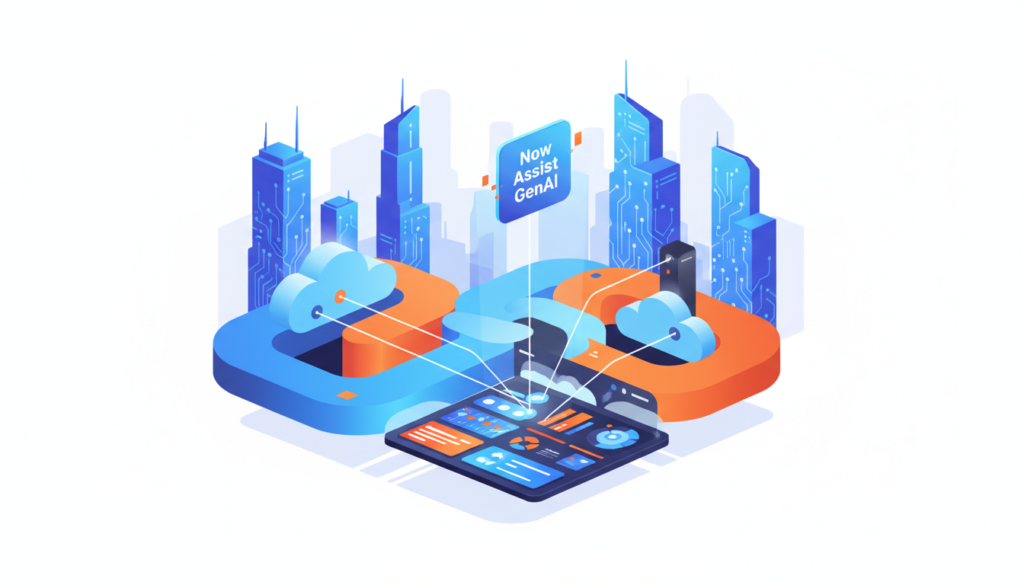
ServiceNow ITOM for hybrid visibility with Now Assist GenAI
ServiceNow ITOM brings CMDB-backed discovery and event handling into a single governance-led platform for hybrid estates.
What it does: ITOM combines discovery, event management, anomaly detection, and health log analysis tied to a central CMDB. That asset context improves triage and speeds resolution by clarifying ownership and dependency chains.
Event management and discovery at scale
Event streams are correlated and prioritized to match enterprise workflows. Routing aligns incidents with approval gates and change management to reduce risky fixes.
Now Assist GenAI value
Now Assist provides fast summaries, smarter routing, and task automation to raise throughput for large IT teams. Automation is policy-driven and auditable for compliance needs.
Integration and governance
ServiceNow integrates with Azure, AWS, Cisco, VMware, and GCP. Implementation is complex; success requires standardizing workflows, integrations, and access models across ITSM and ITOM.
Best fit: large organizations with multi-vendor infrastructure, strict security and compliance needs, and an existing ServiceNow footprint.
| Capability | What to expect | Why it matters |
|---|---|---|
| Discovery + CMDB | Accurate asset mapping and dependency context | Faster RCA and clear ownership |
| Event management | Correlation, prioritization, routed workflows | Scales incident handling with approvals |
| Now Assist GenAI | Summaries, smart routing, task automation | Improves team throughput and audit trails |
| Governance | RBAC, audit logs, policy controls | Supports security and compliance requirements |
PagerDuty for real-time incident response and on-call orchestration
PagerDuty acts as the incident control layer that turns noisy alerts into coordinated action across on-call teams.
What it is: PagerDuty is a response platform that sits above monitoring tools to centralize incident coordination. It focuses on fast human handoffs, clear escalation, and predictable on-call management.
Alert deduplication, escalation policies, and response coordination
Deduplication groups related alerts to cut noise and reduce on-call fatigue. Escalation policies ensure incidents do not stall when a primary responder is unavailable.
Response coordination links chat, ticketing, and stakeholder updates so handoffs are auditable. That consistency shortens time to resolution and keeps users informed during critical incidents.
- Stack fit: Not a replacement for monitoring — PagerDuty complements monitoring and other tools to improve MTTR.
- Integrations: Works with AWS, Datadog, ServiceNow, Atlassian, Zendesk and other systems for smooth event routing.
- Buying notes: Useful for distributed teams across cities and time zones; validate language and escalation expectations during trial.
Trade-offs & pricing: AI support is basic (suppression and simple escalation). Reporting and multilingual features are limited; validate postmortem and SLA reporting needs before purchase. Pricing in our comparison lists a starting point of $699/month — model your on-call schedules and event volume to assess cost versus operational benefit.
BigPanda for incident intelligence and alert correlation at scale
Incidents often start as a flood of raw alerts that hide the real operational impact beneath noise. BigPanda positions itself as an incident intelligence platform that turns those floods into clear, actionable incidents.
Context-rich incident grouping to reduce downtime and noise
Correlation groups related alerts into a single incident with ownership and impact context. That conversion shrinks alert volume and gives teams a clearer path to resolution.
Where it shines: large enterprises battling alert fatigue
BigPanda fits organizations with multiple monitoring tools from mergers, multi-cloud stacks, or diverse infrastructure. It improves visibility across disparate sources so operations can focus on real problems, not redundant signals.
- Workflow automation: Route incidents into ITSM and collaboration tools to standardize response and speed time to resolution.
- Practical AI scope: AI-powered RCA and impact estimation exist, but the emphasis is on reliable correlation and reasoning rather than flashy generative features.
- Integrations: Connectors to Datadog, Splunk, AppDynamics, Jira, CloudTrail, Slack, and Asana enable end-to-end handling from detection to postmortem.
Adoption guidance: Start with the noisiest alert sources, validate grouping accuracy, and track alert volume reduction and time-to-triage improvements before wider rollout. Pricing is quote-based—plan a pilot that measures outcomes for your teams and governance needs.
Moogsoft for ML-based classification and situational awareness in hybrid environments
In hybrid estates where alerts never stop, Moogsoft helps operations regain situational awareness.

What it does: Moogsoft uses machine learning to group related alerts into coherent incidents. Clustering and correlation reduce noise and speed first-response triage for distributed teams.
Clustering, correlation, and predictive analytics for faster triage
ML-based classification groups signals from cloud, on-prem, and legacy systems into single incidents. That collapse of alerts gives clearer context and fewer pages.
Predictive analytics spot patterns and early anomalies so teams can intervene before issues escalate. The platform focuses on incident triage rather than generative features.
Operational considerations: documentation and support model
Moogsoft integrates with common tools such as AWS, Slack, AppDynamics, New Relic, PagerDuty, and XMatters. Confirm these links early to avoid workflow gaps.
Practical note: The offering is quote-based. Documentation can be sparse and support often leans on community resources. Validate support SLAs and run a pilot on historical incidents.
- Test correlation quality against past incidents to measure alerts collapsed into actionable items.
- Validate data ingestion from your monitoring stack to ensure consistent classification.
- Map integrations to your incident workflows to prevent fragmentation across tools and teams.
| Capability | What to expect | Why it matters |
|---|---|---|
| ML clustering | Groups related alerts into incidents | Reduces noise and improves triage speed |
| Predictive analytics | Detects emerging patterns and anomalies | Allows earlier intervention on issues |
| Integrations | Connects to cloud, monitoring, and incident tools | Keeps workflows unified and auditable |
LogicMonitor for infrastructure visibility with Edwin AI recommendations
LogicMonitor brings clear infrastructure visibility across on-prem, cloud, and network layers so teams can act faster.
Hybrid monitoring and service health scoring: LogicMonitor excels at consistent monitoring for mixed estates. It collects device, instance, and interface data to build unified service views.
Service health scoring turns complex metrics into a simple score. That score helps stakeholders and operations teams speak the same language about system performance.
GenAI interface for faster navigation and incident guidance
Edwin AI offers conversational navigation and incident recommendations. Responders can find dashboards, metrics, or incidents quickly during an outage.
Edwin’s suggestions guide next steps and speed triage for less-experienced responders. That reduces mean time to resolution and improves on-call confidence.
- Integrations: Azure, AWS, Kubernetes, Cisco, IBM AIX, Microsoft 365, Zoom, Twilio — useful for enterprises and MSPs.
- Pricing signal: ~$22/resource/month — scope “resource” carefully (devices, instances, interfaces) to predict costs.
- Best fit: teams that prioritize infrastructure-first monitoring and want a modern, AI-assisted operations experience without heavy APM needs.
| Capability | What to expect | Why it matters |
|---|---|---|
| Service scoring | Standardized health views | Clear stakeholder communication |
| Edwin recommendations | Conversational guidance | Faster triage for responders |
| Integrations | Broad device and cloud links | Works across hybrid estates |
IBM Cloud Pak for AIOps for deep automation and cross-domain ingestion
Dynamic topology and model governance let teams trust automated actions during complex incidents.
What it is: IBM Cloud Pak for AIOps is a platform built for large organizations that need cross-domain ingestion, rich monitoring, and policy-driven automation across hybrid cloud and on-prem infrastructure.
Dynamic topology, event compression, and model management
Dynamic topology keeps dependency maps current so correlation and root-cause analysis are accurate when systems change. That context shortens time to diagnosis.
Event compression collapses floods of alerts into manageable signals. Operators see fewer, higher-quality incidents and spend less time on redundant noise.
Model management gives governance over training, validation, and updates. Large teams benefit from auditable model lifecycles rather than opaque automation.
- Integrations: AWS, Azure, Google Cloud, Datadog, Dynatrace, GitHub, Instana, Jira, and IBM Cloud link engineering and operations workflows.
- Implementation: Quote-based pricing and higher complexity; adopt with a platform team and phased onboarding by domain.
- Compliance & security: Policy-driven actions, audit trails, and model governance support regulated environments and enterprise controls.
| Capability | Value | Why it matters |
|---|---|---|
| Cross-domain ingestion | Unified data for analysis | Better correlation and faster RCA |
| Event compression | Reduced alert volume | Improves operator focus |
| Model management | Governed ML lifecycle | Auditability and safer automation |
Security-focused AIOps and SaaS governance to reduce risk and strengthen compliance
Security and operations now share a single mission: stop identity-driven breaches before they spread.

Why this matters in 2025: SaaS sprawl, identity-based attacks, and hybrid estates create blind spots. Teams must merge telemetry from apps, IdP/IAM, endpoints, networks, and cloud to spot threats early and act fast.
Unified telemetry across SaaS, IdP/IAM, endpoints, networks, and cloud
Consolidating logs, access events, and endpoint signals gives a single view for security and operations. That unified data reduces false leads and speeds root-cause work.
Automated containment and access governance: RBAC and JIT access
UEBA-style baselining flags unusual logins, privilege escalations, and strange downloads. Correlation and deduplication then elevate true threats, cutting noise for responders.
Containment examples buyers should demand: revoke tokens, disable accounts, quarantine endpoints, and segment or throttle network links. Actions must be policy-driven and auditable with approval gates where needed.
Shadow IT discovery and SaaS risk scoring with CloudEagle.ai and Zluri
Tools such as CloudEagle.ai and Zluri find unmanaged apps, score vendor risk by certification (SOC 2, HIPAA, GDPR), and automate access reviews. These platforms complement classic monitoring and ITOM by filling SaaS visibility gaps.
CloudEagle.ai signals include pricing tiers for SaaS Management and Governance that buyers can model into pilots. For an operational vendor list and deeper context, see this SaaS governance guide.
Compliance outcomes: evidence trails for SOC 2, ISO 27001, and HIPAA-aligned controls
Automated access reviews, RBAC reports, and immutable audit logs create auditor-friendly artifacts. That reduces manual evidence collection and speeds certification cycles for firms.
- Procurement cues: prioritize integrations with Okta, Azure AD, and Google Workspace and demand auditor-ready reports.
- Operational win: fewer false positives, faster containment, and measurable reduction in privileged access risk.
| Feature | What it does | Buyer outcome |
|---|---|---|
| Unified telemetry | Collects SaaS, IdP, endpoint, network, cloud data | Fewer blind spots and faster incident context |
| Automated containment | Token revocation, account disable, quarantine | Limit lateral spread and reduce breach scope |
| Access governance | RBAC, JIT access, periodic reviews | Enforce least privilege and produce audit trails |
Conclusion
Start with a clear pilot that measures how a platform cuts noise and speeds RCA.
Across leading platforms, the consistent value drivers are noise reduction, correlation, faster root-cause analysis, and safe automation. Match tool choice to your telemetry maturity, governance needs, and integration footprint to get the intended operational gains.
For practical selection: ITSM-led teams often favour Freshservice; cloud-observability groups lean toward Datadog or Dynatrace; Splunk ITSI fits KPI-driven service monitoring; ServiceNow and IBM suit governance-heavy hybrid estates; PagerDuty helps incident orchestration; BigPanda and Moogsoft excel at correlation; LogicMonitor focuses on infrastructure visibility.
Run a limited pilot that tracks alert volume, time-to-triage, MTTR, and operator satisfaction. Shortlist 2–3 platforms, confirm integrations with your stack, and request pricing tied to agents, hosts, or ingestion. Validate security controls, access governance, and audit logs before enabling broad self-healing automation.
For adjacent productivity and vendor selection ideas, see this practical guide on useful productivity tools for founders.
FAQs
What are AIOps tools and how do they use artificial intelligence in IT operations?
AIOps tools are platforms that apply artificial intelligence and machine learning to IT operations. They analyze large volumes of data from monitoring systems, logs, and infrastructure components to detect anomalies, identify problems, and automate responses. This helps operations teams reduce downtime, improve service reliability, and manage complex hybrid environments more effectively.
How does machine learning improve monitoring and anomaly detection?
Machine learning models establish dynamic baselines for system behavior using historical and real-time data. These models continuously learn normal patterns and automatically detect anomalies that static thresholds miss. This enables faster identification of performance issues, security risks, and infrastructure failures before they impact users.
Why are AIOps platforms important for modern infrastructure management?
AIOps platforms centralize monitoring, analytics, and automation across cloud and on-prem infrastructure. By correlating data from multiple tools into unified dashboards, they give operations teams clearer visibility, faster root-cause analysis, and automated remediation workflows—improving reliability while lowering operational overhead.
How do AIOps tools strengthen security and governance?
AIOps software integrates security analytics with operational monitoring to detect unusual access behavior, configuration drift, and compliance risks. Automated workflows can revoke access, isolate compromised systems, and maintain audit logs—improving security posture and simplifying regulatory compliance.
What problems can AIOps software solve for IT teams?
AIOps software reduces alert fatigue, improves monitoring accuracy, accelerates incident response, and simplifies infrastructure management. By transforming raw telemetry data into actionable analytics and automated workflows, these tools help teams resolve problems faster, maintain system stability, and deliver better digital experiences.