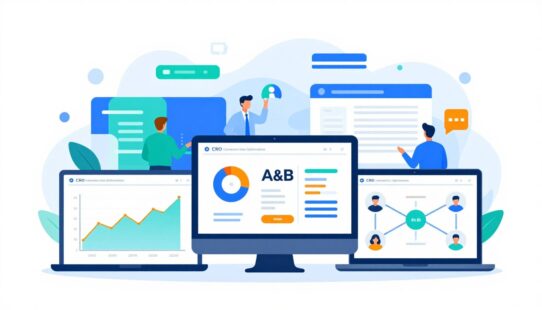




The article opens with a clear promise: this is an ultimate guide that shows how small and mid-size businesses treat change as a step-by-step business program, not a one-time technology purchase.
Leaders will find a focus on measurable outcomes like revenue growth, operational efficiency, and better customer experience. Practical advice helps teams pick high-impact projects that fit tight budgets and limited staff.
Readers learn how to assess maturity, choose tools, and build a roadmap that tracks ROI over time. The piece stresses that transformation covers processes, data, culture, and change management—why many firms miss their goals.
The market is moving fast: multi-trillion-dollar spending creates pressure even on smaller firms. The guide favors incremental wins—pilots, quick wins, and scalable foundations—so the business reduces risk while building long-term capability.
Key Takeaways
- View change as a program, not a single purchase.
- Target projects that drive revenue and cut costs.
- Include people, process, and data in plans.
- Start with pilots and build scalable wins.
- Measure ROI and adjust the roadmap often.
Why Digital Transformation Matters for SMBs Right Now
Right now, improving core systems and workflows gives smaller firms an edge in fast-moving markets. Leaders see change as an ongoing program that ties tech to clear business goals. That focus helps teams pick projects that show quick wins and scale.
Operational efficiency and productivity gains through smarter processes
SMBs boost efficiency by digitizing manual steps and cutting rekeying and disconnected approvals. This reduces errors and shortens cycle times like quotes-to-cash.
Customer experience as a competitive differentiator
Nearly half of companies say better customer experience led them to start change efforts (PwC). Faster response, simple self-service, and consistent support help smaller firms win repeat business.
Scalability, growth, and market pressure
Cloud-first operations let teams collaborate anywhere and scale systems with demand. Market pressure is real: many industries see change as a baseline need, and only about one-third meet their objectives (BCG). Treating the effort as a managed program with milestones improves performance and reduces the cost of late adoption.
- Practical wins come from targeted fixes, not full rebuilds.
Common Digital Transformation Challenges SMBs Need to Plan Around
Many small firms face practical roadblocks that slow progress long before ROI appears. Leaders should spot these issues early so plans stay realistic and work does not disrupt daily service.
Limited budget, high costs, and constrained resources
Constrained resources shape every decision. Teams must balance daily operations with project work without derailing sales or service.
High costs go beyond licenses: implementation, integration, migration, training, and ongoing admin add up. Phased investment reduces risk and spreads costs.
Lack of technical expertise and skills gaps
Many firms lack in-house expertise to evaluate vendors, manage security, and integrate systems. This skill gap slows delivery and raises external support needs.
Resistance, integration, and security
Resistance to change shows up as fear of disruption and role uncertainty. Legacy systems and siloed data block end-to-end visibility and force manual workarounds.
Adding cloud apps and third-party links increases exposure. Cybersecurity needs grow as access points multiply, so management of risk must be planned.
- Why ROI lags: goals are unclear or metrics don’t tie to outcomes, making success hard to prove.
Assessing Digital Maturity and Readiness Before Investing in New Technology
Assessing readiness reveals which projects will deliver the fastest business impact. A practical maturity check reduces waste and focuses investment where it matters most.
What maturity looks like in practice
Digital maturity means clear strategy alignment, repeatable operations, usable data, and a culture that accepts change. It is a mix of systems, processes, and people.
Use frameworks to benchmark gaps
A maturity framework gives a score that compares the firm to peers. That score highlights gaps that block effective transformation and guides a needs-first plan.
Map touchpoints and workflows
Map the customer journey using website analytics, support logs, and sales interactions. This reveals friction that costs retention.
- Document core processes and ownership.
- Capture insights from frontline staff who see daily breakdowns.
- Prioritize areas where low maturity causes the biggest operational or customer impact.
| Assessment Area | Ready | Gap |
|---|---|---|
| Strategy & governance | Leadership alignment on goals | Missing roadmap with metrics |
| Operations & processes | Documented workflows, owner identified | Manual handoffs and delays |
| Data & insights | Central data ownership and basic reporting | Siloed data and inconsistent metrics |
| Customer journey | Tracked touchpoints and analytics | Unaddressed friction points hurting retention |
Use these findings to target improvement areas first. The next section will explain how to turn the assessment into a needs-first plan that leads actual transformation.
Digital transformation strategies for SMBs That Align With Business Goals
Successful change begins by naming the business outcomes leaders will fund—revenue lift, faster fulfillment, higher satisfaction, and stronger data management.
Defining business needs and outcomes
Leaders translate pain points into fundable needs: higher revenue, lower cost-to-serve, quicker order cycles, and reliable reporting.
Business needs framed this way win budget and make trade-offs clear.
Turning initiatives into measurable goals
Each initiative should map to a target and a metric: reduce invoice time by 40%, cut lead response to one hour, or raise online sales 15% in six months.
A needs-first approach to avoid shiny objects
Reject tool rollouts that lack a validation plan. Define the problem, shortlist solutions, run a pilot, then scale.
- Keep the list short. Prioritize quick wins that improve efficiency without adding vendor sprawl.
- Link every project to goals. That alignment lets teams measure ROI and explain why changes happen.
Choosing High-Impact Areas for Transformation Across the Business
Small teams win by choosing projects that deliver clear customer and financial impact fast. This section helps leaders pick the best areas based on impact and feasibility: cost, time, and staff capacity.
Customer experience improvements with CRM and omnichannel support
CRM and omnichannel tools centralize history so staff respond faster and handoffs stay consistent. HubSpot CRM and Salesforce Essentials are common entry paths that scale with the team.
Operations and workflow automation to reduce manual work and errors
Automating invoicing, approvals, and order updates cuts manual re-entry. That leads to measurable error reduction and faster fulfillment.
Data analytics for decision-making, forecasting, and performance insights
Analytics and reporting give leaders timely signals on trends and performance. Good data platforms enable forecasting and quick course corrections.
- Pick areas with clear customer or financial impact first.
- Match each area to internal capacity and a short pilot plan.
- Limit focus to two or three areas to avoid fragmented systems.
| Area | Typical tools | Expected improvement |
|---|---|---|
| Customer experience | HubSpot CRM, Salesforce Essentials | Faster responses, higher retention |
| Operations | Workflow automation platforms | Fewer errors, faster cycle times |
| Data & analytics | BI and reporting tools | Better forecasts, clearer performance |
Choosing a small number of focused areas makes pilots feasible and keeps ROI visible. The next section outlines the core technologies that enable these choices.
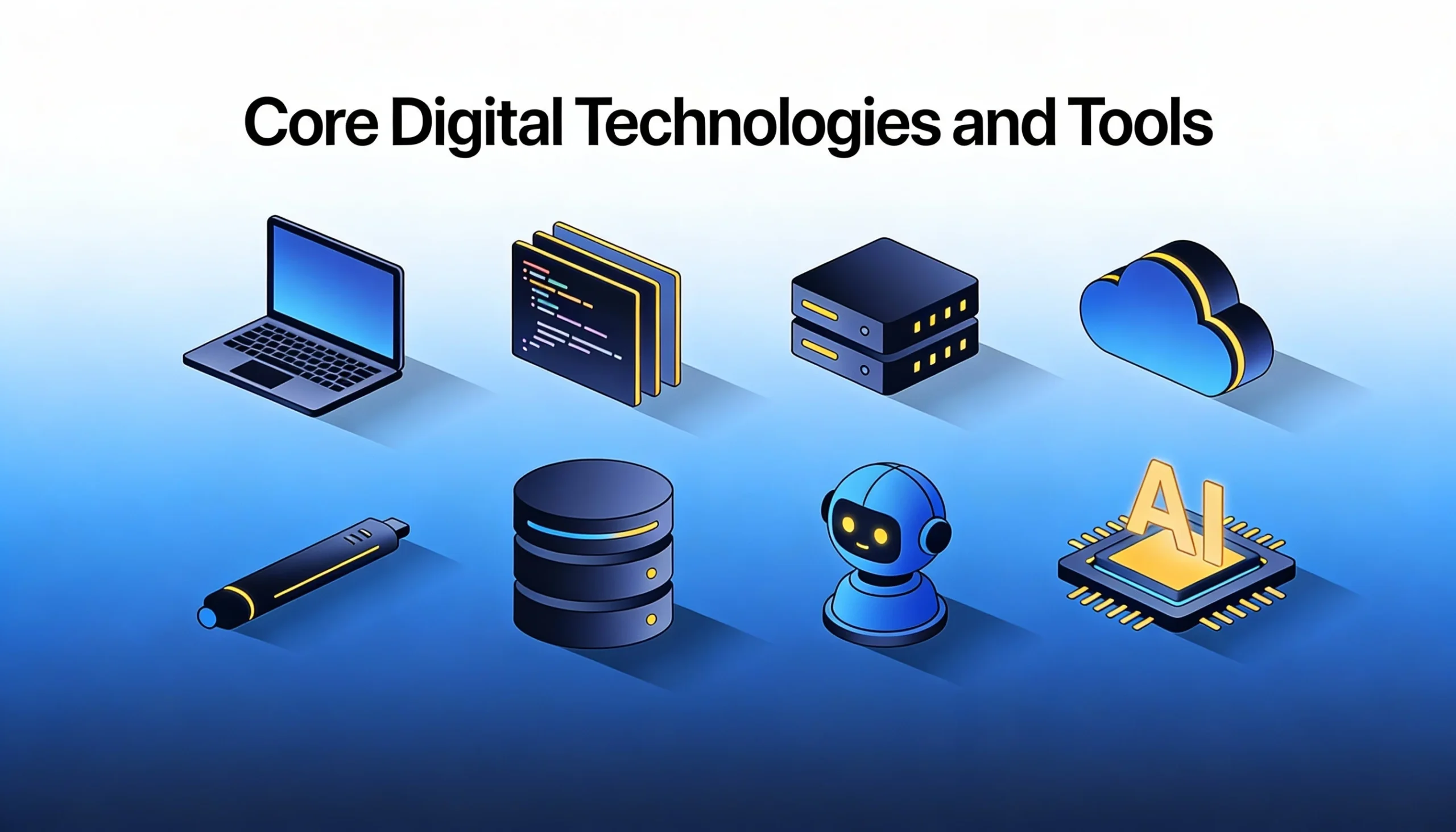
Core Digital Technologies and Tools SMBs Can Leverage
Choosing the right mix of platforms starts with real business problems, not product demos. Teams should list use cases—collaboration, workflow speed, reporting, marketing execution—and then match technologies that solve those needs.
Cloud computing for collaboration, scale, and reduced infrastructure costs
Cloud services cut upfront infrastructure costs and speed deployment. Google Workspace, Microsoft Dynamics 365, and Slack enable remote work and simpler backups. Cloud options let firms scale without large capital expense.
Automation tools to streamline invoicing, marketing, and internal processes
Automation yields fast payback on repetitive tasks. QuickBooks, Wave, Zapier, and Trello can automate invoicing, lead routing, follow-ups, and approvals to reduce errors and free staff time.
Data analytics and business intelligence platforms for actionable insights
Analytics platforms turn raw data into dashboards for forecasting and performance tracking. Power BI and Tableau help leaders spot trends and measure ROI.
Digital marketing platforms for social media, email, and content management
Marketing platforms operationalize campaigns across social media and email. Mailchimp, Canva, Google Analytics, Shopify, and WooCommerce link campaign execution to measurable results.
IoT options for real-time monitoring and smarter asset management
IoT sensors support inventory tracking, predictive maintenance, and energy optimization. These tools reduce downtime and lower operating costs when paired with cloud reporting.
- Selection tips: pick scalable platforms, verify integrations, check vendor support, and measure total cost of ownership—not just subscription fees.
| Use case | Example tools | Expected benefit |
|---|---|---|
| Collaboration | Google Workspace, Slack | Faster communication, centralized files |
| Automation | Zapier, QuickBooks | Fewer manual tasks, lower error rates |
| Analytics | Power BI, Tableau | Clear dashboards, better forecasts |
Building a Practical Roadmap for Digital Transformation Initiatives
A practical plan helps leaders prioritize effort, assign owners, and reduce risk while running changes. It should list initiatives, timelines, milestones, and the budget and personnel needed. The roadmap must stay adaptable as priorities shift.
Phased implementation: pilots to scale
Start with pilots to validate assumptions and measure outcomes. Deliver quick wins next, then expand into longer-term transformation initiatives.
Resource planning
Plan realistic resources: budget, staff time, data cleanup, integration, and process redesign. Build a business case per initiative with expected outcomes, risks, and a clear “definition of done.” This helps management approve based on facts.
Partnering and vendor selection
Choose vendors and consultants who offer implementation services, training, and ongoing support. Evaluate integration capability, security posture, references, and ability to work within small-business constraints.
- Sequence initiatives to avoid peak seasons and compliance deadlines.
- Map each item to KPIs the business will track consistently.
- Document owners, timelines, dependencies, and a plan to manage changes.
| Sequence | Owner | KPI |
|---|---|---|
| Pilot: invoice automation | Ops manager | Invoice cycle time |
| Quick win: lead routing | Sales lead | Lead response time |
| Scale: reporting platform | IT lead | Report adoption rate |
Measuring Success With KPIs, Metrics, and ROI Tracking
Start measurement early: define the business outcomes you expect and pick a few clear KPIs to prove progress. A narrow set of goals helps teams focus on value, not vanity metrics. Set a baseline before rollout so changes can be measured reliably.

Operational efficiency
Key metrics include cost reduction percentage, cycle-time improvements, error rates, and employee productivity. Track these monthly or quarterly to spot trends and validate process changes.
Customer metrics
Measure signals that link to revenue: Net Promoter Score (NPS), retention rate, repeat purchase behavior, first-response time, and resolution speed. These show whether customer experience improvements drive growth.
Digital adoption and progress
Use adoption metrics to prove the program is happening: percentage of processes digitized, cloud migration progress by workload, and user adoption rates for new tools. Adoption gaps often explain weak performance.
Financial impact and ROI
Track revenue growth from online channels, margin gains from automation, and ROI against total costs (subscriptions + implementation + training). Use a consistent formula so leaders can compare initiatives.
- Baseline first: record current performance before changes.
- Track regularly: monthly or quarterly checkpoints reveal what moved the needle.
- Use a simple dashboard: assign an owner so reporting is ongoing, not one-off.
| Category | Example KPI | Cadence |
|---|---|---|
| Operational efficiency | Cost reduction %, cycle time | Monthly |
| Customer | NPS, retention rate, first-response time | Monthly / Quarterly |
| Adoption | % processes digitized, cloud migration % | Quarterly |
| Financial | Revenue growth from channels, ROI | Quarterly |
Consistent measurement enables course correction and increases the chance of long-term success. Keep the list short, link each KPI to a business owner, and review results with a clear decision rule: continue, adjust, or stop.
People, Training, and Change Management That Make Transformation Stick
People determine whether big transformation efforts stick long after the systems and tools are in place.
Involving every level and breaking down silos
Management and frontline staff must co-own changes. Leadership sets priorities while teams validate workflows and flag real constraints.
Cross-functional collaboration reduces handoffs and improves customer experience when sales, service, and operations share the same signals.
Training that fits roles and learning styles
Offer instructor-led sessions for core workflows, hands-on workshops for team leads, and self-paced modules for individual reinforcement. This mix helps learners retain new skills and apply them on the job.
Empowerment with data and decision tools
Give employees reliable dashboards and lightweight tools so they can act without waiting for approvals. Data access speeds decisions and reduces workarounds.
Ongoing support and continuous improvement
Treat training as a rhythm, not a one-time event. Use champions, checklists, internal office hours, and vendor support to sustain adoption as systems evolve.
- Why people matter: strong training and change management cut resistance and raise adoption rates.
- Measured outcomes: fewer workarounds, higher tool use, and more consistent customer experience delivery.
| Focus | Action | Expected result |
|---|---|---|
| Leadership engagement | Regular reviews and clear goals | Faster decisions, aligned teams |
| Role-based training | Instructor-led, workshops, self-paced | Higher competency and tool use |
| Data access | Dashboards and decision tools | Fewer escalations, quicker fixes |
| Support assets | Checklists, champions, vendor support | Steady adoption and ongoing improvement |
Launching, Iterating, and Scaling Digital Transformation Over Time
A strong launch focuses on clear scope, named owners, and a plan to gather quick feedback after go-live. It should define support paths and a short checklist to capture frontline and customer feedback immediately.

Agile execution with sprints and feedback loops
Use sprints to break work into manageable steps. Teams deliver incremental value, spot issues early, and adjust without major rework.
Feedback loops combine frontline input, customer signals, adoption data, and performance reviews on a set cadence. That loop supports rapid course corrections.
Communicating early wins to build momentum
Share short case studies of wins with stakeholders. Clear wins reduce skepticism and win ongoing support.
Publicizing progress also encourages teams to follow new ways of working and keeps sponsors engaged.
Ongoing optimization and scaling
Scale initiatives only after core workflows stabilize and adoption blockers are fixed. This prevents multiplying issues across departments.
Strategy updates should follow changes in business needs, vendor releases, and market pressure. Governance with simple decision rights and review checkpoints keeps performance aligned over time.
- Launch checklist: scope, owner, support path, feedback plan.
- Run sprint cycles with a review cadence and update the roadmap as needs change.
- Promote quick wins to maintain support and fund the next step in the journey.
| Stage | Key Action | Success Signal |
|---|---|---|
| Launch | Define owners and support | Initial feedback logged |
| Iterate | Sprint reviews and fixes | Adoption improves |
| Scale | Stabilize and expand | Measurable performance gains |
Conclusion
The final lesson is simple: pick one high-impact initiative, prove it, then expand with discipline.
Align technology to clear business goals, prioritize customer experience, operations, and data analytics as the primary levers, and keep systems from operating in silos.
Tools and platforms enable progress, but strategy and adoption drive performance. Protect scarce resources by starting small, measuring results, and scaling with governance.
Measurement matters: set goals, track KPIs, and treat each initiative as an investment. Executives report revenue gains when improvements are guided by clear metrics.
Next step: assess maturity, map workflows and touchpoints, and choose one initiative that can deliver a near-term win while building long-term capability.